

The Power of Interactivity in Web Design: Turning Visitors into Active Participants
Beyond Visual Design: Creating Interactive Experiences
Web design is not just about how a website looks. It is also about how it responds to users, adapts to their needs, and helps them achieve their goals. This is where interactivity becomes an essential part of the user experience. Rather than presenting visitors with a static page that they simply read, an interactive website encourages them to take action and responds to those actions with immediate feedback. The result is a more engaging, intuitive, and dynamic experience that makes users feel involved rather than passive.
Interactivity can take many forms, from simple hover effects and image sliders to expandable FAQs, real-time form validation, and product filters. These features may appear relatively minor, but they can have a meaningful impact on how people navigate a website. When users receive immediate feedback, they can understand the results of their actions, explore information more efficiently, and move through the customer journey with fewer obstacles. The key is to ensure that every interaction serves a purpose and makes the overall experience easier or more useful.
Small Interactions That Make a Big Difference
Not every interactive element needs to be complex to deliver value. Sometimes, the smallest details have the greatest impact on usability. A button that changes appearance when hovered over helps users recognize that it is clickable. An expandable FAQ section allows visitors to access additional information without overwhelming the page with text. Instant form validation identifies errors as users enter their details, reducing the likelihood of frustration during submission.
Product filters provide another practical example. Instead of browsing an entire catalogue, customers can narrow down their options according to specific criteria, such as price, category, size, or color. This makes product discovery faster and helps users focus on the options that best match their needs.
These interactions work because they reduce unnecessary effort. Rather than forcing visitors to figure out what to do next or search through irrelevant information, the website provides clear responses and useful ways to move forward. When implemented thoughtfully, even simple interactions can make a website feel significantly more responsive and user-friendly.
Helping Users Find the Right Destination Through Interactive Guidance
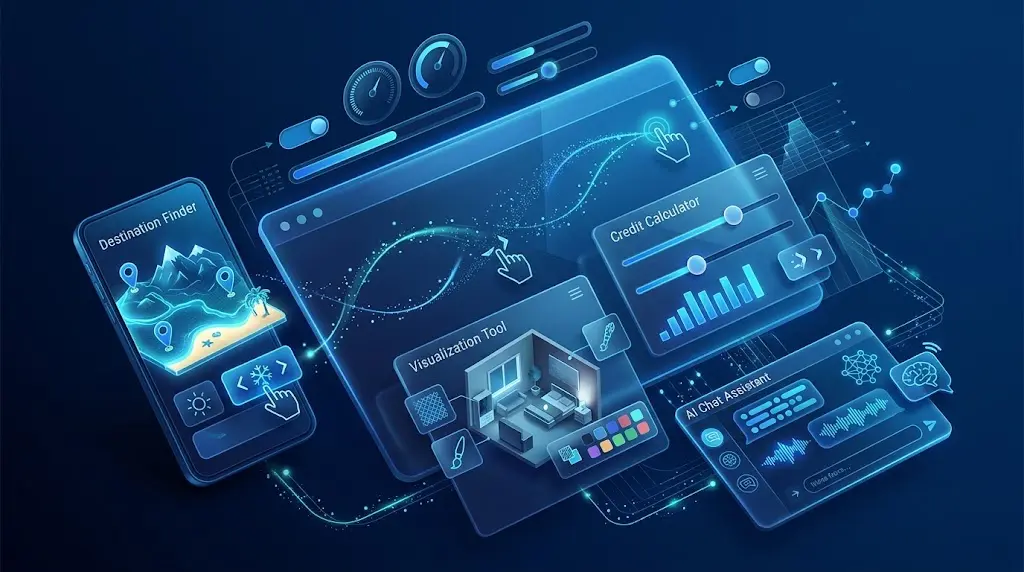
Interactivity becomes even more valuable when it helps users make decisions. At Intactdia, we developed an Interactive Destination Finder for a travel company to simplify the process of choosing a holiday destination. Instead of expecting visitors to browse hundreds of destinations and compare them independently, the website guides them through a series of questions designed to understand their preferences.
Visitors can indicate whether they prefer beaches or mountains, warm weather or cooler climates, luxury resorts or budget-friendly trips, and vibrant nightlife or peaceful surroundings. They can also specify whether they are travelling with family or as a couple and provide an indication of their budget. Based on these answers, the tool immediately recommends destinations that align with their preferences.
The advantage of this approach is that it transforms a potentially overwhelming search into a more manageable and personalized experience. Visitors do not need to understand every available destination before making progress. Instead, the website helps them narrow down their choices step by step, presenting relevant options based on what matters most to them.
From a business perspective, this type of functionality also creates a more meaningful interaction between the company and its potential customers. By helping visitors identify suitable options, the website makes the decision-making process more efficient and creates a natural path toward exploring travel packages or making an enquiry.
Simplifying Financial Decisions with Interactive Calculators
Financial services provide another area where interactivity can deliver tangible value. For a non-bank financial institution, we developed an interactive credit calculator that allows potential customers to estimate their loan payments immediately and compare different financing scenarios.
Traditionally, customers interested in borrowing money may need to contact a representative or request a consultation before they can understand how different loan amounts or repayment periods could affect their payments. An interactive calculator removes much of this initial uncertainty by allowing users to explore the available options independently.
By adjusting the relevant values, visitors can see how different scenarios influence their estimated repayments and gain a clearer understanding of the financial commitment involved. This makes the information more accessible and allows potential customers to approach the next stage of the process with greater confidence.
The value of such a tool extends beyond convenience. It gives users more control over their research, reduces the effort required to obtain basic information, and helps them determine whether a particular financing option is worth pursuing. For the business, it creates a more informative first interaction with potential customers and can encourage qualified enquiries from people who have already explored their options.
Bringing Product Ideas to Life Through Interactive Visualization
When customers purchase products for their homes, making a decision can be difficult without seeing how the product will look in its intended environment. This is particularly true for decorative materials such as wallpaper, where color, pattern, scale, and overall appearance can significantly influence the final result.
For a wallpaper retailer, we developed an interactive visualization tool that allows customers to see how different wallpaper designs would look inside a room before making a purchase. Instead of relying entirely on product photographs or imagining how a particular pattern might fit into their interior, visitors can explore different designs in a more contextual and practical way.
This approach helps address one of the most common challenges in online shopping: the gap between seeing a product on a screen and imagining it in real life. By making the product experience more visual and interactive, the website helps customers evaluate their options and understand how different designs may complement their space.
The result is a more informed purchasing process. Customers can compare alternatives, explore their preferences, and make decisions with greater confidence. For the retailer, reducing uncertainty at this stage can help improve the overall shopping experience and support purchasing decisions.
Enhancing User Experience with AI-Powered Chat Assistants
As websites become more sophisticated, interactive experiences are increasingly extending beyond traditional interface elements. AI-powered chat assistants, for example, can help visitors find relevant information without requiring them to navigate through multiple pages or search manually.
At Intactdia, we have recently integrated an AI-powered chat assistant designed to understand the content across an entire website and provide immediate, context-aware answers to visitors’ questions. Rather than making users locate the relevant service page, search through lengthy descriptions, or navigate several sections to find a specific detail, the assistant allows them to ask questions directly and receive relevant responses.
This changes the way visitors interact with a website. Information becomes easier to access, and users can approach the website in a more natural way by asking questions in their own words. Whether they need clarification about a service, want to understand a particular process, or are looking for specific details, the assistant can help them reach the relevant information more efficiently.
When implemented correctly, this functionality can make a website more accessible and responsive while reducing the effort required to find answers. However, its effectiveness depends on the quality and accuracy of the information it uses, how well it handles questions, and whether it recognizes when a visitor needs assistance from a human representative. AI should support the user journey, not introduce another layer of confusion.
Designing Interactivity Around Business Goals
Effective interactivity is not about adding animations, transitions, or visually impressive effects simply to make a website appear more modern. While these elements can contribute to the overall experience, they are only valuable when they serve a clear purpose. An interaction that looks impressive but slows down navigation or distracts users from important information can create more problems than it solves.
The most effective interactive features are designed around specific user needs and business objectives. A destination finder helps visitors narrow down their choices. A credit calculator makes financial information easier to understand. A product visualization tool reduces uncertainty before a purchase. An AI-powered assistant makes information more accessible. Each of these solutions addresses a particular challenge and provides users with a practical reason to engage with the website.
It is also important to evaluate how these features perform after implementation. User engagement, task completion rates, form submissions, enquiries, and conversions can help determine whether an interactive element is delivering the expected value. By analyzing these outcomes, businesses can identify opportunities to improve the experience and ensure that the functionality continues to support their objectives.
Creating More Meaningful Digital Experiences
Ultimately, interactivity is most effective when it makes a website more useful, not merely more entertaining. The objective is to help visitors find information, understand their options, overcome uncertainty, and take the next step with minimal friction. When every interaction is built around a genuine user need, the website becomes more than a place to browse information. It becomes a practical tool that actively supports the decision-making process.
At Intactdia, we approach interactivity as a strategic part of web development, connecting thoughtful design with functionality that solves real problems. Whether it involves simplifying a complex decision, helping customers visualize a product, providing immediate financial estimates, or making information accessible through AI, the goal remains the same: to create experiences that benefit both users and businesses.
A well-designed interactive website does not simply respond to clicks. It understands what users are trying to achieve and helps them get there more efficiently. That is where interactivity moves beyond a design feature and becomes a meaningful driver of engagement, customer confidence, and business growth.